This term i have two new students joining my class, both students are non-verbal and have no communication system currently set up. A huge focus in special education is communication and many classes at our school will have a variety of systems to support the student with communication.
Communication is at the core of all my lessons as it is woven throughout the class programme. Having acess to communication weather it is through a iPad or a core board is vital. I usually modell lamguage on a large core board for the whole class, the support sdtaff working in my classroom will also support individual students who have funded devices or are trailling devices so that the language that i am using is modelled on their individual devices. It is a time consuming and difficult process which makes it more difficult when you have different students using various devices however seeing the results long term is worth it!
In the holidays i watched a very inspiring Ed Talk video about literacy expert, Sally Clendon. At Sommerville we are fortunate enough to get professional development from Sally, i have implemented many of Sally's literacy recommendations and seen the students success as a result.
If you have students in your classroom who are non-verbal or using AAC (Augmentive and Alternative communication) i would highly recommend looking into Sally Clendon's work.
You can find her short Ed talk video by clicking here.
Monday, July 23, 2018

Wednesday, July 11, 2018
Colourful Somantics
I posted last year on my blog about colourful semantics and how well it can work for students with communication needs.
You can see the previous post by clicking here.
I have started to use the same resources i used last year however i have simplified the activities by focusing on ONE key area. I am going to include colourful semantics activities in my writing rotation.
My students are working on answering questions about the story, for students who do not yet have the language or are non-verbal then using visuals allows them the chance to be able to communicate their answer.
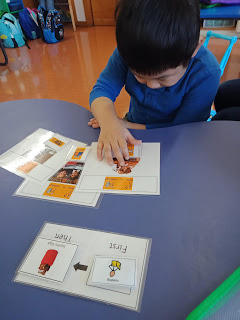
In this activity, the student is working on answering "who" using pictures from the story. Using the colourful semantics system, "who" is coloured orange. He has to look at the picture and choose the correct visual to identify characters from the story.
I will use this programme in my writing rotation as well.
You can see the previous post by clicking here.
I have started to use the same resources i used last year however i have simplified the activities by focusing on ONE key area. I am going to include colourful semantics activities in my writing rotation.
My students are working on answering questions about the story, for students who do not yet have the language or are non-verbal then using visuals allows them the chance to be able to communicate their answer.
In this activity, the student is working on answering "who" using pictures from the story. Using the colourful semantics system, "who" is coloured orange. He has to look at the picture and choose the correct visual to identify characters from the story.
I will use this programme in my writing rotation as well.

There is plenty of resources avalibale online. you can find more information by clicking here.
Friday, June 29, 2018
Student Sucess
This term one of my focus students, Conner, has excelled since starting school. Next term he will be attending one of our satellite classes. It is a good opportunity for him to be able to integrate with his mainstream peers.
In the two terms since he has started school he has learnt to;
- join group activities in the classroom
- complete his morning routine
- write his name
- use his individual timetable so that he understands what he is meant to be doing
- attend to learning activities for an extended period of time (from 5 minutes to 30 minutes). This was a goal for him in the classroom as part of my inquiry.
- reading skills: turning the page, pointing to the words, recognising high frequency words, retelling the story line, identifying the title, answering comprehension questions.
- he has moved from a Level 1 Magenta reader to Level 3 Red reader.
- his high frequency word recognition has increased (see graph).
I look forward to hearing how he progresses in his new classroom. I have two new students starting next term so i will choose another student to add to my focus group.

In the two terms since he has started school he has learnt to;
- join group activities in the classroom
- complete his morning routine
- write his name
- use his individual timetable so that he understands what he is meant to be doing
- attend to learning activities for an extended period of time (from 5 minutes to 30 minutes). This was a goal for him in the classroom as part of my inquiry.
- reading skills: turning the page, pointing to the words, recognising high frequency words, retelling the story line, identifying the title, answering comprehension questions.
- he has moved from a Level 1 Magenta reader to Level 3 Red reader.
- his high frequency word recognition has increased (see graph).
I look forward to hearing how he progresses in his new classroom. I have two new students starting next term so i will choose another student to add to my focus group.

Monday, June 18, 2018
Progress update - Term 2
Term 2 has been a successful one for my students, especially the ones i have outlined in my focus group. When reflecting on this term and what made it successful it has been a combination of building relationships, having high expectations, building predictable routines and implementing a sensory curriculum including opportunities for movement breaks.
Oliver: I have the behavior team on board to assist with his behavior in the classroom, mainly around compliance for non-prefurred tasks. With a behavior plan put in place, Oliver is now more settled. He can complete tasks in a familiar routine such as unpacking his bag and writing his name. He will now sit and attend to his individual reader for short periods of time. I have not been able to assess his alphabet knowledge as of yet however i am hoping that next term i will be able to test him.
Conner: Conner has made the most progress this term. He joins all class group activities and has gone up two reading levels! He is now reading at red level 3 with excellent comprehension. He understands that he needs to complete all work tasks before he is allowed to play and has stopped leaving the table in the middle of a work block.
Benjamin: We have seen a huge increase of functional language being used throughout the day. Benjamin is like a sponge and just soaks up any learning, even when it appears he is not attending to the lesson he is able to show us that he understands the task. Benjamin still continues to run multiple times in circle time but during work tasks he is on task for the duration of the lesson. This term i was able to identify how many high frequency words he can recognise, this is a big breakthrough!
Next term i am keeping my programme relativly similar with a focus on comprehension during reading tasks using visuals to aide understanding of the text.
Oliver: I have the behavior team on board to assist with his behavior in the classroom, mainly around compliance for non-prefurred tasks. With a behavior plan put in place, Oliver is now more settled. He can complete tasks in a familiar routine such as unpacking his bag and writing his name. He will now sit and attend to his individual reader for short periods of time. I have not been able to assess his alphabet knowledge as of yet however i am hoping that next term i will be able to test him.
Conner: Conner has made the most progress this term. He joins all class group activities and has gone up two reading levels! He is now reading at red level 3 with excellent comprehension. He understands that he needs to complete all work tasks before he is allowed to play and has stopped leaving the table in the middle of a work block.
Benjamin: We have seen a huge increase of functional language being used throughout the day. Benjamin is like a sponge and just soaks up any learning, even when it appears he is not attending to the lesson he is able to show us that he understands the task. Benjamin still continues to run multiple times in circle time but during work tasks he is on task for the duration of the lesson. This term i was able to identify how many high frequency words he can recognise, this is a big breakthrough!
Next term i am keeping my programme relativly similar with a focus on comprehension during reading tasks using visuals to aide understanding of the text.
Tuesday, June 5, 2018
Implementing a sensory curriculum
As my students are new to school and routines, I am working on extending the time they will engage in seated activities. As part of my writing, handwriting and math's programme i implement sensory based learning activities as well as seated work tasks so that students who are unable to focus for long periods of time get a "sensory break".
There are heaps of ideas on Pinterest for "sensory tubs". This week i put the "letter of the week" in a tub with jelly balls (can be found at most $2 shops), and words we are learning from our word wall in shredded paper (purchased from looksharp). Other sensory tubs i have used in the past are:
-shaving foam
-flour
-colored rice
-sand
-sago
-kinetic sand


There are heaps of ideas on Pinterest for "sensory tubs". This week i put the "letter of the week" in a tub with jelly balls (can be found at most $2 shops), and words we are learning from our word wall in shredded paper (purchased from looksharp). Other sensory tubs i have used in the past are:
-shaving foam
-flour
-colored rice
-sand
-sago
-kinetic sand


Thursday, May 31, 2018
Addressing sensory needs
My students need regular sensory input throughout the day in order to focus for extended periods of time. For some students this means implementing a "sensory diet".
"A sensory diet is a carefully designed, personalized activity plan that provides the sensory input a person needs to stay focused and organised throughout the day." (Patricia Wilbager, OT)
When i look across my group of students i can recognize that most of my class are sensory seeking; weather it is rocking on their chairs, walking around the room before sitting down, jumping off the chairs, or seeking tactile stimulation. I have worked with students in the past who were tactile defensive (refusal to explore tactile surroundings) and the class OT (occupational therapist) implemented a Wilbarger brush programme as part of a sensory diet. I was amazed at the success of using a brush to stimulate the skin in order to increase active exploration.
My class programme caters to the sensory needs in my classroom with regular sensory breaks offered to my students in order to increase their focus during work tasks. I timetable a movement break every 30 minutes. The breaks vary from jumping on the trampoline, going for a run, sensory play, swing and a exercise circuit. Some of my students such as Benjamin need more breaks in order to remain on task in the classroom. I make sure he goes on the swing for 2 minutes before he is expected to sit.
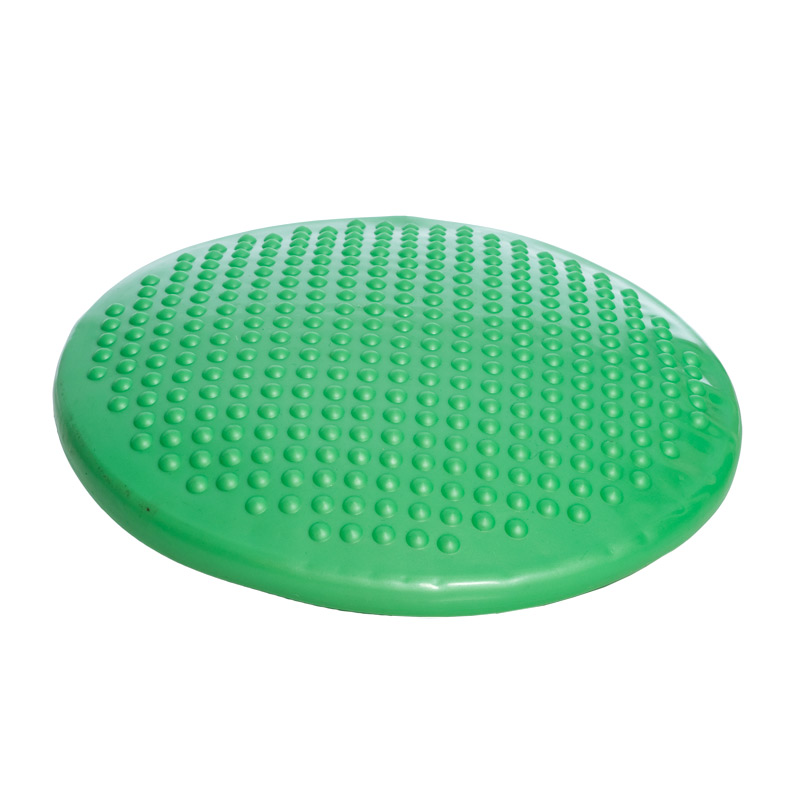
I am currently trialing a few alternative seating alongside the OT that works in my classroom. If you have a student who struggles to focus you could try using a swiss ball to sit on, inflatable cushion, fake grass under their feet, weighted blankets for pressure or a fiddle toy to maintain focus.


"A sensory diet is a carefully designed, personalized activity plan that provides the sensory input a person needs to stay focused and organised throughout the day." (Patricia Wilbager, OT)
When i look across my group of students i can recognize that most of my class are sensory seeking; weather it is rocking on their chairs, walking around the room before sitting down, jumping off the chairs, or seeking tactile stimulation. I have worked with students in the past who were tactile defensive (refusal to explore tactile surroundings) and the class OT (occupational therapist) implemented a Wilbarger brush programme as part of a sensory diet. I was amazed at the success of using a brush to stimulate the skin in order to increase active exploration.
My class programme caters to the sensory needs in my classroom with regular sensory breaks offered to my students in order to increase their focus during work tasks. I timetable a movement break every 30 minutes. The breaks vary from jumping on the trampoline, going for a run, sensory play, swing and a exercise circuit. Some of my students such as Benjamin need more breaks in order to remain on task in the classroom. I make sure he goes on the swing for 2 minutes before he is expected to sit.
I am currently trialing a few alternative seating alongside the OT that works in my classroom. If you have a student who struggles to focus you could try using a swiss ball to sit on, inflatable cushion, fake grass under their feet, weighted blankets for pressure or a fiddle toy to maintain focus.
Thursday, May 24, 2018
Making reading accessible through AAC
As mentioned in previous posts, i now have 4 out of 7 students using AAC (Augmentative and Alternative Communication). I am working on implementing all devices into my class programme which is no easy feat considering one person needs to work individually with that child while using their device and i only have 3 staff members.
However creating opportunities for communication while it should come naturally i have found it is best to plan sessions where i will use each device. I am trying to get my students to carry their devices with them so that they can take ownership over their own communication as well.
Each week i make an activity specific language board to go with their communication device for a student to use while they are reading. This particular student was trialing a device that has sound output and recordable buttons. I used language from their weekly reader and recorded the symbols on the device. For the first time, this student was able to answer questions about the story, and they were able to answer correctly! Because of the success we had during reading, this student is going to trial a similar device with more icons available. From 9 icons on a screen to 32!
Planning communication opportunities isn't always easy in the chaos of a busy classroom however making it part of your new "normal" makes it manageable; especially when you start to see success for that student.

However creating opportunities for communication while it should come naturally i have found it is best to plan sessions where i will use each device. I am trying to get my students to carry their devices with them so that they can take ownership over their own communication as well.
Each week i make an activity specific language board to go with their communication device for a student to use while they are reading. This particular student was trialing a device that has sound output and recordable buttons. I used language from their weekly reader and recorded the symbols on the device. For the first time, this student was able to answer questions about the story, and they were able to answer correctly! Because of the success we had during reading, this student is going to trial a similar device with more icons available. From 9 icons on a screen to 32!
Planning communication opportunities isn't always easy in the chaos of a busy classroom however making it part of your new "normal" makes it manageable; especially when you start to see success for that student.

Subscribe to:
Posts (Atom)