This term i have two new students joining my class, both students are non-verbal and have no communication system currently set up. A huge focus in special education is communication and many classes at our school will have a variety of systems to support the student with communication.
Communication is at the core of all my lessons as it is woven throughout the class programme. Having acess to communication weather it is through a iPad or a core board is vital. I usually modell lamguage on a large core board for the whole class, the support sdtaff working in my classroom will also support individual students who have funded devices or are trailling devices so that the language that i am using is modelled on their individual devices. It is a time consuming and difficult process which makes it more difficult when you have different students using various devices however seeing the results long term is worth it!
In the holidays i watched a very inspiring Ed Talk video about literacy expert, Sally Clendon. At Sommerville we are fortunate enough to get professional development from Sally, i have implemented many of Sally's literacy recommendations and seen the students success as a result.
If you have students in your classroom who are non-verbal or using AAC (Augmentive and Alternative communication) i would highly recommend looking into Sally Clendon's work.
You can find her short Ed talk video by clicking here.
Showing posts with label LResearch. Show all posts
Showing posts with label LResearch. Show all posts
Monday, July 23, 2018

Wednesday, July 11, 2018
Colourful Somantics
I posted last year on my blog about colourful semantics and how well it can work for students with communication needs.
You can see the previous post by clicking here.
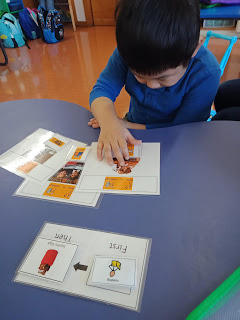
I have started to use the same resources i used last year however i have simplified the activities by focusing on ONE key area. I am going to include colourful semantics activities in my writing rotation.
My students are working on answering questions about the story, for students who do not yet have the language or are non-verbal then using visuals allows them the chance to be able to communicate their answer.
In this activity, the student is working on answering "who" using pictures from the story. Using the colourful semantics system, "who" is coloured orange. He has to look at the picture and choose the correct visual to identify characters from the story.
I will use this programme in my writing rotation as well.
You can see the previous post by clicking here.
I have started to use the same resources i used last year however i have simplified the activities by focusing on ONE key area. I am going to include colourful semantics activities in my writing rotation.
My students are working on answering questions about the story, for students who do not yet have the language or are non-verbal then using visuals allows them the chance to be able to communicate their answer.
In this activity, the student is working on answering "who" using pictures from the story. Using the colourful semantics system, "who" is coloured orange. He has to look at the picture and choose the correct visual to identify characters from the story.
I will use this programme in my writing rotation as well.

There is plenty of resources avalibale online. you can find more information by clicking here.
Friday, June 29, 2018
Student Sucess
This term one of my focus students, Conner, has excelled since starting school. Next term he will be attending one of our satellite classes. It is a good opportunity for him to be able to integrate with his mainstream peers.
In the two terms since he has started school he has learnt to;
- join group activities in the classroom
- complete his morning routine
- write his name
- use his individual timetable so that he understands what he is meant to be doing
- attend to learning activities for an extended period of time (from 5 minutes to 30 minutes). This was a goal for him in the classroom as part of my inquiry.
- reading skills: turning the page, pointing to the words, recognising high frequency words, retelling the story line, identifying the title, answering comprehension questions.
- he has moved from a Level 1 Magenta reader to Level 3 Red reader.
- his high frequency word recognition has increased (see graph).
I look forward to hearing how he progresses in his new classroom. I have two new students starting next term so i will choose another student to add to my focus group.

In the two terms since he has started school he has learnt to;
- join group activities in the classroom
- complete his morning routine
- write his name
- use his individual timetable so that he understands what he is meant to be doing
- attend to learning activities for an extended period of time (from 5 minutes to 30 minutes). This was a goal for him in the classroom as part of my inquiry.
- reading skills: turning the page, pointing to the words, recognising high frequency words, retelling the story line, identifying the title, answering comprehension questions.
- he has moved from a Level 1 Magenta reader to Level 3 Red reader.
- his high frequency word recognition has increased (see graph).
I look forward to hearing how he progresses in his new classroom. I have two new students starting next term so i will choose another student to add to my focus group.

Thursday, May 17, 2018
Engaging students in reading
Since introducing personalised books into my class library i have seen an increase of independent reading by a student who otherwise would have refused to read.
By engaging her in books about topics that she is interested I have been able to assess her pre-reading skills. I know that she is able to hold the book correctly and turn the page. When looking at the book she can look at the pictures and words on the left and then on the right which shows me she knows the left to right direction that text is read.

I download most of my individualised books from a website called Taheel Reader (link is supplied). Taheel Reader is a fantastic resource where people make books and upload them online. They are switch adaptable if you have a student with limited mobility who uses switches and they can also be used on a touch screen. I download and print them out to put in my library however last year my students were able to access them on the computer during independent reading time. I usually always have books in my library printed that are based on my topic as well.
By engaging her in books about topics that she is interested I have been able to assess her pre-reading skills. I know that she is able to hold the book correctly and turn the page. When looking at the book she can look at the pictures and words on the left and then on the right which shows me she knows the left to right direction that text is read.

I download most of my individualised books from a website called Taheel Reader (link is supplied). Taheel Reader is a fantastic resource where people make books and upload them online. They are switch adaptable if you have a student with limited mobility who uses switches and they can also be used on a touch screen. I download and print them out to put in my library however last year my students were able to access them on the computer during independent reading time. I usually always have books in my library printed that are based on my topic as well.
Wednesday, April 4, 2018
ASD and Building Routines
The importance for building predictable routines for children with Autism is paramount for learning however it is important to ensure that the child doesn't become too obsessed with routines. I often hear of families having to drive the same route each day to ensure that the child with Autism doesn't get upset, or wearing the same clothes and eating the same food.
I believe that providing a structured learning environment helps the child to focus on what they are meant to be doing and to block out overstimulating environments. Routines also help to build expectations and ease anxiety for children who cannot decode what is happening in their environment.
Now that my students are familiar with our class routine i am starting to make small changes to make our routine slightly different. This way they learn how to cope with change in a safe environment because life isn't always going to be predictable. I do this by taking a trip to the swings after morning tea instead of reading our big book, or timetabling a surprise on their individual timetables so they cannot anticipate what is going to happen.
 If you have a student who cannot cope with transitioning between tasks then start by
- building a predictable routine (use a visual timetable to help)
- once they are familiar; start making small changes to their day
- adding "surprise" on their timetable
https://www.autismspectrum.org.au/content/establishing-routines
I believe that providing a structured learning environment helps the child to focus on what they are meant to be doing and to block out overstimulating environments. Routines also help to build expectations and ease anxiety for children who cannot decode what is happening in their environment.
Now that my students are familiar with our class routine i am starting to make small changes to make our routine slightly different. This way they learn how to cope with change in a safe environment because life isn't always going to be predictable. I do this by taking a trip to the swings after morning tea instead of reading our big book, or timetabling a surprise on their individual timetables so they cannot anticipate what is going to happen.
 If you have a student who cannot cope with transitioning between tasks then start by
- building a predictable routine (use a visual timetable to help)
- once they are familiar; start making small changes to their day
- adding "surprise" on their timetable
https://www.autismspectrum.org.au/content/establishing-routines
Wednesday, March 7, 2018
Learning Intentions for Shared Reading
Having a clear learning intention prior to every lesson is important for students of any level. Visuals are a great way of sharing what it is you are wanting them to learn.


We are fortunate to have received training at Sommerville from Sally Clendon. She teaches that having specific learning targets shared prior to a lesson means that your students only have to focus on one aspect of the lesson rather than trying to retain information about everything you are reading.
I had great success in my last classroom by writing down on the whiteboard what they were learning that particular day. In my new classroom I have had to adapt the way I teach and deliver content. I made these learning intention boards which i have printed and laminated to use during shared reading. For some books i will make specific learning intentions to go with that story, Eg: we are learning to find out what happened to the mouse.
For each book i make a activity core board which has language from the story in visual form so that my non verbal students can answer questions about the story.
Here are some examples:


Friday, February 16, 2018
Reading Readiness
I am 3 weeks into teaching my new class. I have 8 students with varied strengths and abilities which is a change from the 5 older students i had for the last 2 years. I have been spending time building relationships, observing what they can do and where they are at.
One of the biggest learning challenges I face is, "how do I know they are ready to read?."
When speaking to a friend of mine who teaches a mainstream new entrant class I understood that most students start school and start on a Magenta reader straight away. This was certainly what i observed when I was out on practicum many years ago.
When i look at my group of students, only a handful would be able to attend to a story or sit at a table long enough to engage.
I came across a blog that has been helpful when deciding on who i was going to start on individual readers. The blog mentions 5 key signs that a child is ready to read with the first one being "engagement" which i believe is key to a successful reading journey as well as concepts about print. This year i want to become more familiar with the assessment tool "concepts about print" which is used widely across our school.
https://thisreadingmama.com/ready-to-read-reading-readiness/
One of the biggest learning challenges I face is, "how do I know they are ready to read?."
When speaking to a friend of mine who teaches a mainstream new entrant class I understood that most students start school and start on a Magenta reader straight away. This was certainly what i observed when I was out on practicum many years ago.
When i look at my group of students, only a handful would be able to attend to a story or sit at a table long enough to engage.
I came across a blog that has been helpful when deciding on who i was going to start on individual readers. The blog mentions 5 key signs that a child is ready to read with the first one being "engagement" which i believe is key to a successful reading journey as well as concepts about print. This year i want to become more familiar with the assessment tool "concepts about print" which is used widely across our school.
https://thisreadingmama.com/ready-to-read-reading-readiness/
Tuesday, November 28, 2017
Making Words - Update
For the past two terms i have been using a programme called "making words" which was suggested by Dr Sally Clendon. At Sommerville we are fortunate enough to get regular professional development by Sally who focuses on a "balanced literacy curriculum".
I have blogged about this programme previously which you can find here and here.
I have been using this programme with one of my students who struggles with decoding and spelling who is currently reading at level 17/18.
I have noticed huge changes in Evan since using this programme daily. There are mini-lessons which use specific letters and a "special" word that they have to build up to spelling. The lessons start off by spelling small letters like "as". The teacher gives specific instructions to help them to build more complex words, eg; add a letter to the start of the word "at" to spell the word "pat". The student has to use their sound knowledge to word out where the letters have to go. Evan's confidence with spelling has grown so much that now he doesn't need as specific prompts, now we say to him "use three letters to spell the word cat". The managing self skills that Evan has gained has transferred to his writing. Previously he was unable to write a sentence without adult support, this week Evan wrote a story about his cow puppet independently.

I have blogged about this programme previously which you can find here and here.
I have been using this programme with one of my students who struggles with decoding and spelling who is currently reading at level 17/18.
I have noticed huge changes in Evan since using this programme daily. There are mini-lessons which use specific letters and a "special" word that they have to build up to spelling. The lessons start off by spelling small letters like "as". The teacher gives specific instructions to help them to build more complex words, eg; add a letter to the start of the word "at" to spell the word "pat". The student has to use their sound knowledge to word out where the letters have to go. Evan's confidence with spelling has grown so much that now he doesn't need as specific prompts, now we say to him "use three letters to spell the word cat". The managing self skills that Evan has gained has transferred to his writing. Previously he was unable to write a sentence without adult support, this week Evan wrote a story about his cow puppet independently.

Tuesday, November 21, 2017
Colourful Semantics
I use Colourful semantics in my classroom to help develop students early foundation literacy skills. It is a good programme for developing sentence structure. At Sommerville many of the teachers use colourful semantics as a system to support students with their reading and writing using the colour coding as a prompt. A colleague of mine, Lidia, has always used this programme as part of her reading programme and when i started at Sommerville i adopted a similar approach.
Colourful semantics is an approach created by Alison Bryan. It is aimed at helping to develop their grammer but is rooted in the meaning of words. It works by students reassembling sentenctes by putting them in order by their colour coded stages. There are different levels within the programme.
- WHO : Orange
- WHAT DOING : Yellow
- WHAT : Green
- WHERE : Blue
Below is a website with more information:
http://integratedtreatmentservices.co.uk/our-approaches/speech-therapy-approaches/colourful-semantics-2/
A huge thank you to Lidia who has inspired me to structure my reading activities using colourful semantics. Here are some examples of how i use colourful semantics in my classroom.

Colourful semantics is an approach created by Alison Bryan. It is aimed at helping to develop their grammer but is rooted in the meaning of words. It works by students reassembling sentenctes by putting them in order by their colour coded stages. There are different levels within the programme.
- WHO : Orange
- WHAT DOING : Yellow
- WHAT : Green
- WHERE : Blue
Below is a website with more information:
http://integratedtreatmentservices.co.uk/our-approaches/speech-therapy-approaches/colourful-semantics-2/
A huge thank you to Lidia who has inspired me to structure my reading activities using colourful semantics. Here are some examples of how i use colourful semantics in my classroom.

Wednesday, November 1, 2017
Working with Words
 Evan is a very competent reader but has limited understanding about grammar. I am working on "filling in the gaps" in his understanding he can however get anxious when learning anything new if he doesn't immediately know the answer.
I found a resource in our library with printable games to teach different skills which fits in with his literacy goals this term. They are games that are motivating and engaging, Evan was unaware that he was learning a new skill. Towards the end of the lesson he was able to circle the adjective in each sentence after playing the game.
Below is a video of how Evan used the adjective cards to make an appropriate sentence with the winter picture scene.
Friday, September 29, 2017
Blanks Level of Questioning
Toby is currently reading at Magenta (2) however he has the sight word knowledge to be able to read at a much higher level but he does not yet have the skills to be able to answer questions related to the story. Comprehension for children with disabilities can be very challenging as many of the questions can be abstract.
My students SLT (speech language therapist) suggested that we start getting Toby to respond to simple instructions through varying levels of questioning. She gave me some resources to use in class based on "Marion Blanks Level of Questioning". As i became familiar with her activities that she made i started to make my own that linked with his weekly reader. Below is a video of Toby using the resources i have made. He completes these activities 4x a week and also takes them home. I have written instructions so everyone involved knows how to use them.
For more information see the website below:
http://askaspeechie.com.au/wp-content/uploads/2015/04/Blank-handout.pdf
My students SLT (speech language therapist) suggested that we start getting Toby to respond to simple instructions through varying levels of questioning. She gave me some resources to use in class based on "Marion Blanks Level of Questioning". As i became familiar with her activities that she made i started to make my own that linked with his weekly reader. Below is a video of Toby using the resources i have made. He completes these activities 4x a week and also takes them home. I have written instructions so everyone involved knows how to use them.
For more information see the website below:
http://askaspeechie.com.au/wp-content/uploads/2015/04/Blank-handout.pdf
Wednesday, August 9, 2017
Taking Risks with Reading
 My inquiry this year is the link between the key competency of "Managing Self" and my students reading levels. One of my students that I am focusing on doesn't like to take risks with his reading. Instead of sounding words out he will ask me what the word is, even if he has the skills to decode the word on his own. I have built a good relationship with this student as he has been in my class for almost two years. A year ago he would never have tried this activity for the fear of getting it wrong. The importance of building strong relationships with our students is imperative to their success, especially with students who display more challenging behavior.
http://educationtothecore.com/2015/12/ways-to-build-stronger-relationships-with-your-students/
Friday, August 4, 2017
Positive Behaviour Strategies
At Sommerville we use a positive behavior approach to manage challenging behavior in the classroom.
Sometimes the function of the behavior is unclear and we need to collect observational data to find out what is causing the behavior. I have been using the same system for over a year and i have found it very useful for students with challenging behavior because it is student driven and allows them the opportunity to think about their own behavior to earn rewards.
 Each of my students focuses on a specific and individualized learning goal to manage their own behavior in the classroom such as..
- using a quiet voice in the classroom
- using "gentle hands"
- being kind to my friends
The students earn stars on their charts to earn free play at the end of the day. They need 4/5 or a full 5 stars to earn free play. Most of the students manage their own charts by themselves, however if they do not earn a star we do not focus on the negative behavior, instead we focus on how many more they need to earn free play.
There are some excellent resources available on the TKI website.
http://pb4l.tki.org.nz/Encourage-Positive-Behaviours/Support-material
Sometimes the function of the behavior is unclear and we need to collect observational data to find out what is causing the behavior. I have been using the same system for over a year and i have found it very useful for students with challenging behavior because it is student driven and allows them the opportunity to think about their own behavior to earn rewards.
 Each of my students focuses on a specific and individualized learning goal to manage their own behavior in the classroom such as..
- using a quiet voice in the classroom
- using "gentle hands"
- being kind to my friends
The students earn stars on their charts to earn free play at the end of the day. They need 4/5 or a full 5 stars to earn free play. Most of the students manage their own charts by themselves, however if they do not earn a star we do not focus on the negative behavior, instead we focus on how many more they need to earn free play.
There are some excellent resources available on the TKI website.
http://pb4l.tki.org.nz/Encourage-Positive-Behaviours/Support-material
Wednesday, May 10, 2017
Lighting the Literacy Fire
At our school we have been under Dr Sally Clendon's guidance to implement literacy strategies in both reading and writing.
I have been making my way through Jill Eggleton's book "Lighting the Literacy Fire" and many of her teachings marry well with Sally Clendon's.

I have been making my way through Jill Eggleton's book "Lighting the Literacy Fire" and many of her teachings marry well with Sally Clendon's.
I have been using Jill's book to inquire into my own reading programme. In her book she outlines a list of "teacher targets" which i am working towards this term to ensure my reading programme has all the qualities of growing skilled readers. She suggests that in order to establish a balanced reading programme students should have opportunities to "read with, to and by students daily". Sally Clendon spreads the same message however some texts need to be adapted for my learners so they are accessible.
Subscribe to:
Posts (Atom)